Saturday, 22 September 2012

Auranagbad

Days 27-30
We are now back in Mumbai after 3 hectic days sight seeing around Aurangabad. At the moment we are just hanging about trying to kill time before we catch our train to Goa tonight. We had a good few days in Aurangabad even though it was not at all relaxing with all the cultural stops and very early starts. Still it leaves us ready for a week in Goa.
An early start at 4:30 am on Wednesday (19th) was more than adequate space for pulling out of Mumbai at 6:10 however you can never be sure especially in India. It was our first train trip by standard 2nd class, and we were nervous that it would provide us with too many interesting moments that a journey from A to B requires. Still it was the only class available to Aurangabad so we were going to have to make do and it didn't involve sleeping on it so decided to go for it. As it turned out, it was fine and apart from uncomfortable seats there was no big dramas. In fact it was a lot more entertaining than our experiences in 2nd Class Air-Con. For entertainment here was a baby being passed around the carriage that was the image of Pebbles from the Flintstones, then there were the kids performing dance routines and songs for money, and of course a man who had disgustingly long fingernails who got into a fight about a seat with the Flintstones baby's family. The conductor had to be called and after a lot of to-ing and fro-ing he eventually relented and we were soon on our way through the beautiful Western Ghats up to the Deccan Plateau which forms the core of inland India.
Up on the Deccan plane lies our destination, the city of Aurangabad. The city gained its name from our old Mughal friend Aurangzeb who decided to make it his capital for a time. It was logical enough thing to do as it would have been more central in the Mughal Empire than Agra and Delhi and he had spent much of his time here expanding firstly his father's (Shah Jehan) and then his own lands. After his death though came the city's decline, he would have done well to perhaps check the history books as a few hundred years previously, One of the Delhi Sultans, Tuglaq decided that it would be a good idea to move his capital here from Delhi. This attempt also failed but we visited the site of the old capital today so I will go through what happened in a few paragraphs.
On Thursday we visited the Ajanta caves, 105km (60miles) to the north of Auranagbad. The caves were built by Buddhists beginning at 200BC and were used and expanded up until 6th century AD when the site appears to have moved to Elora. The site of the caves is on the bend of a gorge cut by a river into the basalt rock. As if the gorge had laid down a challenge to them in rock cutting by the river, a group of Buddhists decided that it would be a good idea to cut devotional caves into the shear face of the cave, and for good measure to decorate them with frescoes. The affect is amazing, by the time they were finished 30 caves were cut into the gorge. The caves fall into 2 basic types, the chaityas which are chapel type buildings with stupas at the rear, and the biharas which are monasteries based on a square courtyard area with a rear sanctuary of Buddha. The chiseling required defies belief and this is all before the days of hydraulics or pneumatics. Stupas, columns, altars, statues and decorations are all chiseled out of the stone with the finest of detail. Not content with all the chiseling and scraping the cave dwellers decided that it would also be a good idea to start painting frescoes in the caves, many of which are still intact today. The low light and gradual wear of the pigments though means that you certainly don't get the same affect of the originals but it gives you an idea of their original splendour. After hours of wandering the caves in the sweltering heat we decided we weren't warm enough, so we hiked up to top of the opposite river bank to get a panorama view of the caves entrances and the gorge waterfall.


After another early night and early start we had three sights to see yesterday. We hired an auto rickshaw for the day to see the sights around Aruagabad, however the first action of the auto was to break down, he was promptly replaced by another one and we were soon on our way to the ruins of Daulatabad 15km from the Aurangabad. Daulatabad was a fort and city made famous by Tuglaq who was the Sultan of Delhi in 1327. In his infinite wisdom he decided that after conquering it, it was going to become his capital and proceeded to move it here from Delhi. The logistics of moving the buildings the 1300km to his new capital were going to prove too much and he made do with marching the entire population south. The march involved extreme hardship, many people didn't want to go including one blind man who was punished by the Sultan and had his legs tied to a horse and dragged to the Deccan, however only one of his legs ever got to Daulatabad. One in six of the marchers died and the whole operation proved to be completely pointless, as 2 years after they reached the new city the water ran out and Tuglaq decided to march them all back to Delhi again. The remains of the old city remain today and while they are over grown you can see what the crazy sultan had in mind. There is a series of ramparts which seem pretty impenetrable on their own, expect that they also surround a giant rock which has a fortress on top. The rock was steep enough for the defenders though and the bottom half of it is chiseled into a shear face which drops into a nasty looking moat. Even at 8.30 in the morning the climb to the top was tough and sweaty but there are great views of the city's ramparts and the huge minaret of the old city towering below.

After a quick bout of photos we made our way down and we were soon on our way to the Elora caves.
After the Ajanta caves appear to have went into a decline around the 5th and 6th centuries AD, which coincided with a revival of Hinduism, the local leader decided that a fresh start was required and although they still had Buddhist caves in Elora the main ones are Hindu as well as a few Jain caves. Not satisfied with the amount of chiseling required at Ajanta, the builders of Elora weren't going to use a rock that had been precut by a river instead they went straight in and down into bare rock. The main cave, the Kailasanath Temple required a crazy amount of work to complete. Its size reminds me of a medium sized quarry gouged out of the rock, and this is before the age of dynamite or any real machinery. Not only did they carve out all that rock but they left behind a huge mound of rock which they then proceeded to chip and carve into until they had gouged out a huge temple, two life sized elephants, two 7 metre pillars as well as side caves and temples. The amount of work required by hand and chisel is just bewildering. Photos don't do it justice mainly because it is hard to get a good view of the entire temple complex and its difficult to put the scale of the place into perspective. The remaining caves are impressive too but after seeing the mighty Kailasanath Temple they all seem to pale into significance. The only question remaining is: Which is better Elora or Ajanta? My wife thinks Ajanta but I on the other hand think that the Kailasanath sways the balance. Either way it's a close call and they surely must be a challenger to the rock carving in Petra, Jordan as the greatest rock carving in the world and if you happen to be on the Deccan with a spare couple of days check them out.

After the Elora caves we grabbed lunch and headed for the Bibi Ka Maqbara, which is better known as the "Mini Taj". In some sort of attempt to recreate history or greatness Aruangzeb's son Azam Shah decided that he would build a mausoleum for his late mother as a replica of the Taj Mahal that his grandfather built in Agra. Even though it was for his dead wife, Aurangzeb wasn't the most flamboyant of chaps and he decided that the money could be better spent building his armies or expanding his empire. As a result the building which wasn't shaping up to much of a replica anyway floundered and instead of marble, whitewash was used to get the white affect. The result is well as you can see for yourself in the photos, nowhere near the greatness of the Taj. The plaster and maintenance aside, its a lesson in proportions, the minarets dwarf the main structure which looks too thin and and scrimpy anyway. To be fair though it would be a mightily impressive building if the Taj didn't exist. Thing is though the Taj does exist and this was intended to be a replica and deserved to be judged as such therefore the other nickname it is known by does it more justice than "Mini Taj" and that is is "The poor man's Taj".

Today we had another 5am start for a 6am train to Mumbai. It was quite uneventful except for an Indian family who got extremely confused by which seats they were in and after a lot of counting of seats they eventually saw the seat numbers and sat down. Another bout of confusion followed when they realised that they were all a row out and had to shift again, it was a full half hour after they entered the train before they were seated in their correct seats!
Mumbai is now more of a drag that previously because we don't really want to be going through here again however our 2AC sleeper to Goa doesn't leave until 11.30 this evening so we have a lot of time to kill. We will be resting up in the hippy hangout of Goa for a week. Hopefully the weather and our insides will be kind enough this time to give us the rest we feel we deserve!
Meanwhile Indian politics seems to lurch from crisis to crisis. In a bid to raise capital the government has put up the price of diesel and are going to allow foreign retailers into India. This has caused consternation on the news channels, people are talking about a general strike, non ruling party politicians are pulling out of the government and the opposition are calling for the Prime Minister to resign. Not that different from "Coalgate" a few weeks back, which seems to have been forgotten about. The Prime Minister even went on TV last night and gave the insightful words to the public " Money doesn't grow on trees". And I though Irish politics were bad...
In any case I won't have another post before the All-Ireland final, which takes place tomorrow so I am now putting it on the line: I am going for Donegal! Just don't mention Leo McLoone's punch on Joe McMahon last year, Jim McGuinness's attitude or their attempts to win matches 0-1 to 0-0. Actually come on Mayo! No really I would be happy to see Donegal win and they can rely on support from their neighbours in Tyrone. But I would be equally happy for Mayo who have endured a lot of disappointment over the past 50 years or so. As for the match itself hopefully I will be able to listen to it online in Goa, I would be overjoyed if I could find somewhere that was showing it but I think this is an impossible ask.

Tuesday, 18 September 2012

Mumbai

Days 24 -26
We have arrived in Mumbai safe and well and we are liking it a lot! The streets are clean, our hotel is in a great area, its relatively hassle free and most importantly there is no rain and although its hot, not so bad that we cant walk around.
As we left Darjeeling on Sunday morning the rain still came down, now well into its fifth day. We were also hearing that Sikkim was having the exact same weather so we were glad that we had made the decision to leave the mountains and fly to Mumbai. I would also like to comment on Marmot jackets (I must get the exact type). Now I spent a fair bit of cash on that jacket, which as anyone will know is a big deal for me :-) but I didn't mind because I thought that it would work ok. To be fair in Ireland i never had a problem, but when faced with the Monsoon in India it reached product failure - it leaks! The back of the hood leaks water down the back of your neck and is extremely annoying. So my advise is only buy Marmot rain jackets if your are jumping in and out of light rain for short periods otherwise buy a poncho!  
We were worried about reaching Siliguiri airport in time, with different potential interruptions, but in the end none transpired and we were at the airport 4 hours in advance. While we were checking in we saw Indian labour v. Western technology and processes in a nutshell. There is a huge labour force in India and while that should mean that a lot of things get done it doesn't always work out like that. Instead what happens is that there is someone for every single job or maybe two or three! For example if you go into a restaurant there might be 7 or 8 waiters standing around in a deserted restaurant and they will stand over your table until you are done a little annoying and disconcerting. In any case as we were checking in at the airport there was no less than 5 helpers for the checkin clerk. The other 5 guys were luggage handlers, two of whom put our bags on the scale (which wasn't working!). Once the clerk checked us in a guy on the other side of the scale took our bags off and there was 2 other guys waiting to be handed our luggage and they took off with our bags off to luggage land. In the west this whole process is handled by the check in clerk and a series of conveyors but in India labour is cheap!
Our flights were pleasant although seriously lacking in knee room, I would enjoy seeing my brother getting into a GoAir seat! We transferred in Delhi airport which delighted in telling us it was the World's second best airport! In fairness it was nice although I would suggest that they should give free Wi-Fi and they could be up to No.1. After our second flight and a snooze for myself we were soon in Mumbai and after a taxi to our hotel we were soon sound asleep.
Mumbai is the city of dreams, home to the world's biggest film industry Bollywood and people flock here from across India with dreams of stardom. As a result Mumbai is the largest city by population in India (and fourth in the world) with 20.5 million calling it home within the metropolitan area. Most of these people however end up living in the many slums and Mumbai is home to Asia's biggest slum Dharavi. Originally a small fishing village Mumbai or Bombay as it was then known was taken over the East India company in 1665. Although because it was separated by the rest of British India in Bengal is never really flourished until the East India Company managed to take territory that could link it to Bengal in the early 19th century. Bombay as it was then known then took off as the major port for India, it was the closest to Europe and with the railways starting to link India, Bombay was the premier location to trade with on the subcontinent. The British built numerous civic buildings and churches in various unique architectural styles usually combining Indian with European styles. In 2000 Bombay had its name changed to Mumbai, but even this wasn't enough to stop sectarian tensions boiling over on a number of occasions. These rampages leave 100s or 1000s dead when they erupt although none received as much coverage as the attacks by terrorist groups on the trains and of course the most famous of all in 2008 when sea borne terrorists took over the Taj hotel and shot anything that moved leaving 173 people dead.
The terrorists were all killed bar one who is awaiting execution and security has been seriously tightened around the city, which was evident from our stroll along the waterfront to the Gateway to India. The Gateway was built in 1924 to commemorate the visit of George V visit. Its built in the Indo-Sarcenic style and this along with its location at the head of Mumbai sticking in the Arabian Sea gives it a very grand stature. We were surprised at the reduced requests for photos at the arch from Indian tourists and we decided we would do a sight seeing tour all the way to our next location, the train station. And how impressed we were with Mumbai, the streets are clean, there are clear footpaths to walk on, no tuktuks and most importantly virtually no gawkers or hawkers. The walk took us past some fine looking colonial era buildings all the way to our destination, Mumbai Central train station known as Chhatrapati Shivaji Terminius formerly known as Victoria Terminus.

Undoubtedly the legacy of the British period in modern India is the railways and Victoria Terminus must be the crowning glory of the network. As a railway station it is ridiculous, looking more like a college, it actually reminded me of my University, Queens in Belfast, however there is much more to it than Queen's Lanyon building. Although it was designed by English architect Frederick William Stevens in the same Victorian neo-gothic style as Queen's it seems to also have the traditional Indian styles of Mughal and Hindu thrown in as well as a bit of European Baroque for good measure. The result is amazing but crazy, its fantasy really.

Our actually purpose of visiting the train station was to try and get our tickets and after another visit today we finally have them all to Aurangabad and then to Goa. Following our excursion to the train station we headed to the cinema to catch a Bollywood film. While waiting to get into the theatre my wife actually got pointed out for littering by the security guard at the cinema! Surely a first in the history of this country, but it was all the more funny by the fact there were no bins and she had only left an empty water bottle on a table. The guard lead my wife behind the food stand where there was a random plastic bag and told her that was where she was to throw her rubbish. Clearly obvious for any member of the public who wished to deposit rubbish. I laughed out loud at this but it drew no reaction from the guard, it all made perfect sense to him!
The film itself was a comedy, about the love between a deaf and dumb man and a mentally disabled woman. No film company in the west could ever get away with it but apart from a few cringe worthy politically incorrect scenes (which the audience thought were hilarious!) it wasn't too bad and we quite enjoyed it. It was also set in Darjeeling so alot of rain seemed to feature. It was also quite easy to follow despite the fact that it was almost entirely in Hindi.
Apart from drinking nasty overpriced larger out of a very strange contraption in the famous Leopold's bar and a fantastic Chinese lunch this afternoon the only thing of note we have done is to visit the Prince of Wales Museum. An enjoyable enough museum, nothing really groundbreaking apart from a very detailed and delicate ivory box and a stuffed White Tiger, but apparently you can see a live one in the Delhi Zoo.
Tomorrow we are off very early in the morning to  Aurangabad  to see the Elora and Ajanta Caves and from there to finally relax (we hope!) on the famous beaches of Goa.
I searched the internet yesterday to try and get the hurling final results. The hurling final is actually on the 30th, but I was shocked to learn about the death of Ulster and Ireland rugby player Nevin Spence. He was a promising back and only 22 years old. He died in an awful tragedy along with his father and brother in an accident, where they were all overcome by slurry fumes on their farm in Hillsborough County Down. As a farmer's son I know that there are many dangers on a farm but these silent deadly fumes lurking in slurry tanks are one of the scariest. My heart goes out to the remaining family members. May they Rest In Peace.

Saturday, 15 September 2012

Darjeeling!!!!

Day 22
This is just a quick post to let you know whats happening as our plans have changed again and much to our frustrations we are still in Darjeeling. It has been raining here constantly for at least 72 hours and counting.... It seriously hasn't stopped once! As a result there was a landslide on our chosen route to Sikkim and the road is now closed so we are still in Darjeeling. After a readjustment of our options we have decided to take a plane south to Mumbai tomorrow, where we will arrive tomorrow night.
I once saw a documentary about the world's wettest place, Mawsynram, Meghalaya State in the East of India, which is a few hundred miles from Darjeeling. One of the things that I found difficult to believe was that residents said that it once rained for 2 years without stopping. After being in the midst of the wrath of the Monsoon in Darjeeling I can now believe it. In Ireland it can rain every day for 50 days, but it doesn't rain all day everyday! Of course there are times when it can rain all day maybe even for two days but it will stop and give some respite before hitting you again with another shower or some drizzle. Here it has rained non stop for 3 days solid, usually heavy, sometimes light but one thing has been consistent and that has been water coming from the sky, and still it comes! It is extremely frustrating and to compound this as we were dreading setting off this morning through the downpour the restaurant owner told us about the landslide and there would be no jeeps going to Pelling in Sikkim. So along with the landslide, my wife's trepidation about the mountain roads and the the prospect of getting stuck in the hills we have resigned to defeat from seeing Sikkim. Also the prospect of staying in damp old Darjeeling is not a great one either, so unfortunately we have had to accept that we will not get to see the Himalayas on this trip. :-( Which is a serious disappointment as the mountains would be a definite highlight of any trip to India.
On the back of this we decided to head south with a trip to the Andaman Islands via Calcutta which was to come next on our itinerary. We began searching flights to the tropical islands in the Bay on Bengal, however the flights appear to have shot up by 3 times their original price, so we decided against this option. Our only other option appears to be to take up our Southern India leg of the trip and we decided on booking a flight to Mumbai (Bombay) via the local airport in Siliguri, which is a  3 hour jeep trip back down the mountains but at least after that we skip a torturous train journey across India. A bit of careless booking later (by myself!) means that we are leaving sooner than intended, but it worked out as it will see us arrive in Mumbai by tomorrow evening.
Our current predicament aside as I am sure you are aware world events have got a little bit nasty as they tend to do from time to time. I am not going to comment either way on the subject and hopefully the whole episode should blow over soon, and our travels in India hopefully should not be affected. Also sorry for the lack of photos in this post but there has been nothing worth photographing only grey white cloud!

Friday, 14 September 2012

Darjeeling

Days 18-21
We're on our fourth day in Darjeeling and unfortunately after initially looking promising the hill station has gradually went down hill since we have been here. Its still a fantastic little town but the weather has deteriorated badly along with our health meaning that our activities and sights have been limited. I would have liked to do a post much sooner so I would like to apologise to any regular readers. In any case I will take up our story from where we left off.
Our late train from Mhugal Sari Train Station just got later and in the end the train arrived at our destination station 4 hours late, before we caught a jeep to Darjeeling. The hills start very abruptly and steeply seemingly rising straight up out of the hot plains and as if to illustrate the affect of the monsoon, the hills were shrouded in cloud. It was 3 hours of ascending through switch backs and bumpy roads. Our newly acquired German friend and I were enjoying the amazing view as we went up however my wife was terrified, not helped my our drivers technique of negotiating the switchbacks. This involved driving as fast as the road would allow him up to the bend and then taking a wide line and allowing momentum to take him around the hairpin.
After making our way through the tea plantations and quaint villages we reached Darjeeling and to our surprise when we arrived there was no touts or rickshaws. One taxi driver enquired for a lift however we declined his 200 rupee offer and again to our surprise he wouldn't haggle so we set off on foot to our guest house. Our guest house was substantially cheaper than our previous locations as there is no need for AC in the hills. The guest house has a panoramic view around Darjeeling including the tea plantations and India's highest and the world's third highest mountain Kanchenjunga. Unfortunately for us, all we have managed so far was a brief glimpse down onto the tea plantations as the clouds have been relentlessly swirling and building obscuring our view. After much soul searching though we have decided that we will stay up in the hills until we catch a glimpse of the mountains.
Darjeeling itself was first founded by the British East India Company, however after their Army of Retribution during the Mutiny/Rebellion of 1857 the company was dissolved by the British Government, and governance of India was taken over by the British Crown under the name the British Raj. The Raj developed Darjeeling as it is today, which was a summer retreat from sweltering Calcutta and they built a little piece of England in the mountains with churches, Victorian houses and weather to match. A narrow gauge railway was built to whisk the great and the good of the Raj up to the mountains which is still in operation today and along with the similar railways to Shimla in the North and Ooty in the south was declared a World Heritage Site by UNESCO. The railway is still operated as a steam train and is known as the Toy Train, but unfortunately a ride on the toy train would be entirely pointless in the current conditions as the only view would be of white cloud.
Darjeeling looks like an Alpine resort as it is perched on the side of a hill. However it has the feel of an affluent Nepali town as the population is made up of mainly ethnic Nepalis with a few Indians and Tibetans thrown in. The people of the area have been campaigning for an independent state for a few decades and this reached it peak after a few political assassinations. The Gurkha symbol of the crossed knifes is everywhere and the people  look and behave differently from the rest of India. This comes somewhat as a relief as the stares and hassling are greatly reduced, although there are Indian tourists here which means that they do take photos of us, mostly on the sly and are also quite starry. The town is extremely clean (by Indian standards!) and there are no cows gallivanting the streets, although there is still a substantial feral dog population, they appear to be much better fed that their counterparts on the plains. The town also shuts down by 9pm along with the clouds wandering the streets give the town an eerie ghost town feel at night.
Our activities here have been light on the ground but we did make it to the zoo on Wednesday, which is small but has a lot of rare animals. Although we intend to do a safari later on our trip, the chances of seeing a tiger are rare so we thought at least this would be a good opportunity to see one in India however he didn't make a showing for us as he was hiding in one of his enclosure's caves. Although to brighten our day we did see the even more elusive snow leopard strutting about his enclosure and a Himalayan Bear which looked keen on jumping out of us enclosure! Next to the zoo is the Himalayan mountaineering institute, which is a small museum documenting the mountaineering activities throughout the 20th century. Interestingly Sherpa Tenzing Norgay, one of the two first ascendants of Everest lived in Darjeeling and he was a director of the Institute before his death in 1986.
By this stage in the day my illness was starting to come on, although it was the evening before it got in full flow (literary!). With a cold fever and fluid flushing all directions with a viscosity completely unsuitable for any hydraulic pump, I struggled through the night before feeling gradually better throughout yesterday. My improvement though, was mirrored by my wife's deterioration and as I was holding in my first full meal yesterday evening my wife was going through the very same symptoms as I was.
Sitting having breakfast this morning suddenly a very familiar sound erupted to anyone in the North of Ireland, a pipe band! We looked out and what was coming towards us only a full on pipe band (Yes, Bagpipes!). The colours of the coffin were also familiar, that of the Indian Flag saffron (which looked very orange to me!), white and green!. As it paraded past us in the familiar rain we enquired what is was from the restaurant owner. He told us that this was the funeral of a Freedom Fighter who fought against the British. Now I have heard about funerals for Freedom Fighters who fought against the British before but I had never heard of one headed by a pipe band! But maybe Northern Ireland could use this as an example as the way forward .
Keeping or getting anything dry in Darjeeling is proving near impossible as the rain is near constant and the fact that we are living in a cloud means that any clothing hung out to dry appears more likely to get wet than dry! But a slight respite in the rain and with my wife appearing to be on the mend we decided on climbing Observatory Hill above the town. Although as we suspected there was nothing there to observe only cloud there was a number of temples and to lift my wife's spirits there a couple of troops of monkeys to greet us and scavenge for food. Now I am not the greatest fan of these creatures, viewing them as somewhere between a mix of feral cats, rats and magpies. But my wife thinks they are "the cutest things ever!" and had a great time feeding them popcorn amongst the temples.
From here we head on to the mountain state of Sikkim and hopefully a glimpse of the mountains.
The All-Ireland hurling final ended in a draw last Sunday so hopefully Galway haven't missed the boat for beating the seasoned Kilkenny this coming Sunday. Also congrats to Andy Murray on winning the US open, even though he has the personality of a crow at the end of the day it was thoroughly deserved.

Tuesday, 11 September 2012

Varanasi

Days 15-17
We are currently in Darjeeling in the foothills of the Himalayas after coming here from Varanasi, however I will keep the two locations to separate posts as they are such a contrast.
Before leaving Agra we decided to get our hands on some sweets/candy that we had seen advertised on TV. The sweets are called "Londonderry"! We nearly fell off the bed laughing when we saw the advertisement, so we decided that we should seek them out for different reasons. My wife merely wanted to taste them. I on the other hand wanted to write a letter to the company that the sweets should be renamed "Derry/Londonderry", "Maiden City, "Stroke City",  or maybe just "Saunter on". At the very least they should launch another few brands of sweets called "Derry" and "Doire".  We asked a restaurant owner about these sweets and where we could get them and apparently they were available on every street corner. I tired to explain the humour around these sweets and why it was funny to us but his reply was "Yes but you can also get "Dairy Milk". Either my story was lost on him or he thought how ludicrous is it having a city without a name that people can agree upon. But India also has controversies over city names as they have renamed all of their major cities. We were having a chat with some South Indians we had meet in our guest house and I had mentioned "Madras" in the conversation, I was immediately interrupted and corrected with "Chennai!" In any case we found the controversial named sweets at the next shop and for the record they taste quite similar to Wurther's Original.

Varanasi also known as Baneras is a Hindu holy city on the banks of the River Ganges. It is the city of Lord Shiva (the destroyer god) and each day thousands of Hindus go down the steps of the ghats on the shores of the river to bathe and wash their sins away in the sacred river.We were not expecting to like this city as it has a fearsome reputation as being dirty and crowded even by Indian standards. When I was in Nepal 10 years ago I meet a Dutch guy who had just come from Varanasi and to say that he wasn't impressed is a serious understatement. He thought that it was absolutely disgusting as the bathers share the water with raw sewage and dead bodies sometimes wash up on the ghats. So armed with this perception and fearful of what we would find there so we decided to just book in for one night at the hotel.
Throughout our trip so far we have had frequent lashings from monsoon showers. The monsoon is caused by the hot air on continental India building up during April and May, this invites the cooler moist air to rush in from the ocean until it forced up by the great wall of the Himalayas. Upon rising it cools and bubbles up the clouds of the monsoon, spawning the greatest wet season on the planet. In a cruel twist of fate for the mountains the great rains which they help spawn, in turn create the humongous rivers of the Ganges and Brahmaputra, which along with their tributaries erode the mountains and carry the Himalayan dust and rock down to the sea. However it is the silt rich flow of the Ganges that brings life and fertility to the crowded plains of Northern India, and it is here at Varanasi that we first encounter this river in full flood from the aforementioned rains. We had imagined that we would see the ghats with their temples hugging the river side but the river was swollen a full 6 or 7metres (maybe more!) and most of the ghats along with many of the temples were completely covered.
This made sightseeing on the ghats nearly pointless and almost impossible. Normally you can walk along the ghats for 4 miles but the height of the swell made this impossible.Undeterred we tried to make our way around at least some of the ghats via the side streets, however this proved difficult as the banks of the river are steep and it was extremely hot and sticky. At 7pm every evening a ceremony takes places on the Dasahvamedha Ghat, we decided to investigate. Despite our best intentions, an Italian couple asked us to team up with them in a boat to watch the ceremony from the river. Although it only cost us 125 rupees, it proved to be a total waste of money as we could have viewed the ceremony better from the shore. To be honest we weren't even sure what the ceremony was all about, it seemed to consist of a lot of chanting about Shiva and Krishna and waving flamed mini Christmas trees around. To our horror the Italian even tipped our boatman, who had done nothing except pull the boat with ropes about 10 metres into the water!
There is a citywide 11pm curfew in place in Varanasi and a lot of visible armed security. We discovered this security is for the temples and shrines, some of which are the holiest in Hinduism. If a right wing rival religious group decided that it would be a good idea to damage any of these shrines it would undoubtedly cause the underlying tensions between the religious groups to erupt. When these revenge killings boil over the numbers that are left dead are staggering. In 2002 some Hindu activists were burned in an accidental train fire, however rumours spread that Muslims were responsible and 2000 were left dead in "reprisals" . In 1983 Indra Gandhi was shot dead by her Sikh bodyguard after she ordered an attack on the Sikh temple. 3000 Sikhs were left dead after being mostly burned to death in revenge attacks. And of course the worst came after the Partition of India between Pakistan and India, when whole groups of Muslims, Sikhs and Hindus trapped on the wrong side of the new border decided to make their way to their new homeland. The refugees had to journey through rival territory and many were butchered, trains of refugees arrived at their destination full only of hacked, or burned corpses. In the end the most conservative estimates put the number dead at 0.5 -1million after a few months of savagery. So understandably the Indian government is keen to avoid any repeats of these catastrophes.
At sunrise 1000s of pilgrims come down to the river each morning to wash away their sins and this spectacle gives inspiration to many visitors but to others they see this as a bunch of people taking their morning bath. Unfortunately as two practical minded people we proved to be in the later category! This mass bathing is supposed to be best viewed from the river however with the river so swollen and fast the small row boats are not allowed out on it, so we declined against getting ripped off again and viewed bathing from the shore. However we did get to see a good sunrise over the Ganges and sure an early start never hurt anyone (except my wife!). As for the bathing itself I was decidedly unimpressed one way or the other. It just looked like mass bathing to me and the fact they were doing it in a dirty river didn't bother me much, as I thought we had encountered more revolting sights in India. My wife on the other hand though that it was revolting, helped in no small part by a ghat we had been had walked on the previous evening which we had to tiptoe around human, dog and cow excrement.
We then headed off to the main burning ghat to view the funeral pyres. A young Australian had explained to us in great detail the previous evening about how he had watched the skin blistering on the corpses and any other gory details he could think off. So we were expecting we would react to this in some way, either with sadness, disgust or horror. We reached a view point overlooking the pyres and there they were, burning remains blistering and sizzling in the morning sun over their wooden pyres. Once fully burned the ashes were cleared up and dumped in the river. Then another pyre would be built, and another corpse would be brought along to go through the same process. It looked like an industrial operation. Also there did not appear to be any family around, or any sorrow or grief, just about a dozen or so guys hard at work burning bodies. Neither of us felt much at this whole process, apart from anger at a boy who tried very cheekily to get us to "donate" to help buy wood for the pyres. My wife's reaction to an Irish wake was much worse, but as we discussed afterwards that was because of the personal aspect to a wake, where as this seemed so impersonal and public.
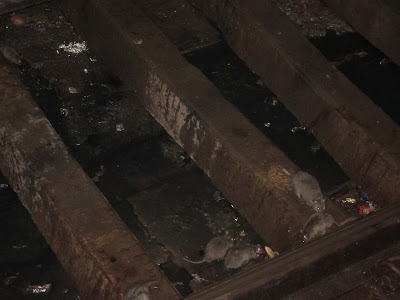
So all in all Varanasi has was thoroughly disappointing for us. We were expecting to have a reaction one way or the other but after all the dirt, squalor, and scamming we experienced we must have built up an immunity to it. We caught our train that evening from Mughal Sari train station 15km from Varanasi. Our train was 2 hours late and it left us with my worst view of Varanasi and that was the sight of hundreds of rats, the tracks themselves were swimming with these vermin and was really a shocking sight.
It was time to get off these plains as the smell, squalor, crowds and attention have worn our senses for too long. So we are off to the foothills of the Himalayas and the British hill station of Darjeeling. Where the cool damp air, tea and pubs should give us a bit of relief and a taste of home, which along with the sight of the snow clad peaks will inspire us to continue our Indian Odyssey.

Friday, 7 September 2012

Agra

Days 12-15
Before catching our overnight train to Agra we went to a performance of Rajasthani culture in Udapuir. It consisted of music and dancing with the various outfits from the difference areas of Rajasthan. There was also a performance from a puppeteer but the highlight came at the end when one of the ladies finished the show with unbelievable display of dancing while balancing pots on her head. At the climax she had a total of 6 pots on her head. Which were taller (and probably heavier!) than herself! It was nice way to end our stay in Udapuir as it was a relaxed and enjoyable place.
 We could only get 3rd class AC coach to Agra, which actually isn't that much worse than 2nd class AC. It has an extra bunk per seat and the beds are a little smaller and consequently a fitful nights sleep for me, however my wife slept soundly. We awoke to a much greener environment than Rajasthan. Crops seemed to be grown a lot more consistently in the countryside. I could only recognise rice and maize but I am pretty sure than there was also millet among others. As Agra shanty towns started to meet us we were treated to our first sight of that most Indian of stereotypes, public defecation. There was at least 4 guys squatting down having a dump on the track next to our train. One fully grown man was facing the train and giving us a full frontal as he relieved himself. I had known that we would see this in India but was still shocked, not so much at the act itself but more how unashamed this gentleman was. Although after thinking about it, he was going to have to give a full frontal to someone and he may as well give it to a trainload of passengers, most of whom he would never see again as opposed to facing the shanty town where he lived with his friends and family. Some of whom were sitting only a few metres away playing cards. It was not the last time that Agra would expose us to this, just this morning on the way to this very internet cafe we came across a grassy area by the side of the road where a child was also squatting, we soon realised we were in the walking along an open latrine and there was human feces everywhere.
After checking into our home-stay in Agra we decided we would spend the afternoon checking the route to the Taj Mahal as we planned to be there by sunrise the next day. After following the badly explained route by our host we reached the West gate of the Taj after what seemed like a long time. On deciding that we could go a shorter route back I foolishly made off in the direction I though we should through the side streets to the south of the Taj. These were a complete an utter maze and after 30-40minutes we were now hopelessly lost in a run down residential warren. There was no tourists, tuktuks or land marks to help us out of there. To make matters worse it was getting dark. We asked a few locals for directions, but still we couldn't find a way out. Our stops for directions had now attracted a host of local children in our wake. We started to get worried but kept moving. At last in the distance we seen lights and the noise of a main road, we seen a collection of tuktuks and negotiated a price back to our home-stay, and we could relax. Although I don't think at any point we were in any real danger it was a frightening enough to be playing the Pied Piper through an Indian neighbourhood and I was very cross at myself for letting it happen, especially with my wife there, and it was definitely an experience that I will learn from!
The next day we awoke at dawn and got a taxi to the Taj, after paying 15times the Indian entry fee to the Taj we entered the complex through its entrance gate and there laid out before us was the gardens, paths and pools all leading the way to the Taj Mahal, and what a jaw dropping sight it is. Trying to describe the Taj in words seems futile, words just don't do it justice! I will use one word to describe its effect on us and that is mesmerising. During our 2 and a half hours in the Taj the whole time we could not take our eyes of it. There are other buildings in the complex which are magnificent in their own right but the gleaming marble perfection of the Taj continually draws your eye. There is the word to describe the Taj, perfection, it is without a doubt the worlds most perfect building and easily the prettiest I have seen. The proportions, symmetry and presentation of the Taj are whats makes it this. The complex's other buildings, the gardens all leading up to the marble square (plinth) on which the Taj sits give it the perfect platform to show it off. Then the minarets and domes complement each other perfectly and along with the ridiculous symmetry combine to make the Taj the fantastic building it is. There are many more taller and larger buildings. In terms of architecture it was not ground breaking, Haia Sofia in Istanbul was built over a 1000 years before hand and had a much larger dome. Countless baroque buildings are much more ornate. The Gothic English and French cathedrals are much more dramatic, but none even come close to the perfection of the Taj. After taking countless photographs, wandering through the gardens we had exhausted the Taj but we still wanted to gawk open mouthed as the morning sun made the Taj glisten like a mirage of heaven.

And indeed that is how it was built to be, as an Islamic image of heaven when it was commissioned by the Mogul Emperor Shah Jehan. It is a mausoleum for his favourite wife, Mumtax Muhal who died after giving birth to their 14th child. The Taj itself was completed in 1653, 22 years after her death. Shah Jehan actually ended up there himself after his son Aruangzeb over threw and him and left him imprisoned in the Red Fort across the bend in the Yumua River. He spent out his days staring at the Taj until his death, after which his remains where brought to the Taj to rest alongside his wife.

After returning to the hotel we got breakfast and our helpful host was panicking that we would not be able to get tickets for our next destination Varansi, so we took a tuktuk to the train station. The tourist line was headed up by Indians most of which seemed to be cutting the queue, there were a few other tourist in the line and we decided to apply some Western standards and stop the queue/line jumping and cutting by stopping all the guys who wandered to the front of the queue and told them, "there is a line, go to the back". They seemed to get the message and after a nod they would disappear off to their own queue. In fairness some Indians were eligible to be in the tourist queue such as "freedom fighters", not sure if that would work for Translink! After our policing of the queue it soon got moving and after a dash for a photocopy of my passport we soon had our 2AC tickets for Varanasi and where on our way to the Red Fort.
Agra Fort (or in Agra "the Red Fort") was the seat of the Mughals until Shah Jahn decided to make it Delhi and built another Red Fort there. However officially for his son, Aruangzeb Agra was actually his seat of power but he spent most of his time expanding the Mughal empire. History doesn't paint a great picture of Aruangzeb and after his father took ill he seized power by defeating him in battle. He then proceeded to kill all his brothers and imprisoned his father in the Fort. Maybe the guilt got to him and that's why he spent his time battling all over the Indian subcontinent, it unlikely though as his religious fanaticism meant that he disapproved of his father's alliances and influences from Hinduism. However his campaigning meant that at the height of his powers he reigned over 1/4 of the world's population and collected a tribute of £38,624,680 - in the year 1690! Meanwhile a small battle in some uncivilised corner of Europe was taking place. After his death the empire broke up and the Mughals remained in Delhi until the rebellion of 1857. The fort itself is much more impressive than the equivalent one in Delhi, the marble places, harems and mosques are still in tact. Unlike in Delhi which were destroyed in 1857 by the brutal razing armies of the East India company. However impressive as it is, visitors are constantly drawn to the edge of the fort where you can see out over the river to the domes of the Taj, even from here the sight of the Taj dominates!

Clouds meant that we declined the sunset view of the Taj, but perhaps we will have more luck this evening before our train journey to Varanasi. For those of you that don't know Varanasi is the famous Hindu pilgrim city on the banks of the Ganges where thousands go down the steps of the ghats each morning to bathe in the River. Its not everyone's cup of tea as there is raw sewage and feces in the river along with the pilgrims. I can say now we definitely won't be joining them in that river!
Meanwhile in Indian politics the "Coalgate" controversy rumbles on and the latest I have heard is that Parliament is still stalled with the opposition constantly shouting for Prime Minister Singh to resign. Its highly unlikely that anything worthwhile will be done about it. With the example that it sets at the top level it is hardly surprising the corruption and scamming that takes place in this country.  On the home sports front good luck to Galway and Joe Canning when they take on Kilkenny in the All-Ireland hurling final on Sunday. Also after everything I am starting to lean towards Donegal for the football final, as after all they are a neighbouring county of ours and gave us support when Tyrone where in finals, but I still could can be swayed, so let me know if you think I shouldn't! Also looks like Alberto Contrador is back to his rightful place as a grand tour winner after his ridiculous ban, great to see the world's best cyclist where he belongs. Also disappointed about the world's greatest tennis player being knocked out of the American Open "but eh Roger, at least you looked good losing!"
Also I have gotten a few emails of support, thanks a lot guys, and also the comments should be working now, let me know if they still aren't.

Tuesday, 4 September 2012

Jophur & Udapuir

Days 9-12
Our final day in Jaisalmer was spent sitting around waiting for our evening train to depart to Jodhpur. It was incredibility hot, too hot for any sort of sight seeing and to be honest apart from the fort, the desert, and the stunning havelis there didn't seem to a lot else we could do there anyway.
Our train pulled into Jodphur's hectic station which I now accept is the norm for India, and our guesthouse pickup was there to met us in the hustle and quickly whizzed us to the homestay. Our hosts were Mr and Mrs Singh, an affluent couple living in a large house in Jodphur suburbs with no less than 8 staff to run the place for the 2 of them and their guests (we were the only guests). Over the course of our stay we discovered that Mr Singh was a 6th cousin once removed ( I think) from the current Maharaja (Indian King) of Jodphur and attended the wedding of the Maharaja's son a few years previous. Like myself he also was educated by the Irish Christian Brothers in a boarding school in Mount Abu, a hill station in Rajasthan along with other privileged Indian boys. At school, when learning about the Christian Brother's work in other countries I imagined (I am pretty sure it was implied by the school though!) that the Brother's did missionary work in countries like India, educating the street children and helping out the poor of India's slums. But, here they were running boarding schools for the rich and making a tidy profit no doubt!
We took a tour of the Mehrangarh Fort and the Umaid Bhavan Palace, better know as Jodphur Palace. The fort was built by the Rathore clan in the 15th century for extra security and what a natural fortress this is. Rising up above the Old City on a protruding rock, my wife commented that it is very similar set up to Edinburgh castle, it reminded me of something from Indiana Jones the Temple of Doom! The Rathores are a clan of Rajputs and their Maharaja (Indian King) had to be a skilled diplomat to retain his position and hold all of the clans together. This diplomacy stood them in good stead when the Moghuls came around and they ensured that they were well in with the rulers of India's Premier empire by marrying off their princesses to Moghul aristocracy and exchanging gifts with their Muslim overlords. Indeed by the time Shah Jahan came around he was actually 3/4 Rajput! However Shah Jahan's son, Aurangzeb was more of a zealot and he loathed the Rathores and their Hindu faith and he made war with them. However the Rathore's were slippy customers and after initially fleeing their fort they were soon back in their fortress in Jodphur after Aruangzeb's death. Aurangzeb reign signalled the end of the Moghul dominance in India and they were never as great again. The Rathores on the other hand were smart enough to befriend the British when the time came and are still there to this day. While Indra Ghandi ensured that none of India's Maharajas have any political power anymore they are still wealthy beyond belief as our visit to the palace provides ample evidence off this.
The information at Jodphur Palace told us that it was built in the 1930's as part of a "Famine Relief Program" for Jodphur. I smirked at this, as there was similar programs to build a series of follys around Ireland during the potato famine. Looking at it from a 21st century point of view, while we acknowledge that  providing work, pay and food to starving thousands of people is keeping them alive, at the end of day it is taking advantage of their misfortune. However I don't have any doubt that the older sites we have visited were built using questionable labour methods, its just that they weren't documented at the time. In any case the palace itself is a magnificent building sitting atop a hill on the outskirts of the city. Unfortunately we could only see a tiny part of this building along with a collection of some of the Maharaja's vintage car collection including 3 RollsRoyce. Indeed as we were leaving there was a 1947 Buick was  pulling out of the elite hotel which encompasses most of the palace, which will set you back a cool $800 a night.
That evening we had dinner and a discussion on tourism and drinking culture with the Singh's friends and work colleagues. The food was fantastic, easily the best we have had to date in India. It was also interesting to have a conversation with some Indians who weren't hell bent on trying to flog us something or rip us off .
The next day we were up early for a bus ride to the lake city of Udapuir. We were told that the journey would take six or six and a half hours , maybe seven. A full eight hours later we trundled our way into Udapuir after a journey where the distance to Udapuir seemed to be increasing! Occasionally we would catch a glimpse of sign that said Udapuir 32km and 10minutes up the road we would see another sign that said Udapuir  35km. Our conclusion was that the bus driver and conductor were scouring the hinterlands of Udapuir looking for business. In any case it left us thoroughly frustrated and in bad humour by the time we we arrived in the ciy itself. A downpour as we were arriving only added to our anger and after checking in and a brief nap we set about exploring Udapuir in our foul mood. A young Indian fellow almost felt the full wrath of my frustration when he cut it in front of my wife at a turnstile for pedestrians. I had went through the turnstile when my wife who was following exclaimed, "Excuse Me!" I turned around, saw that this fellow had cut in front of her, saw red, and decided to push the turnstile back on him. My wife then entered the turnstile and went through. I passed on some words of wisdom to the young chap that I often received from my father "you would need to learn some manners!". To my surprise he was incredibly obliging through the whole episode, he seemed to accept that he was in the wrong and that I was just righting that wrong. It was either that or he seen that I had the red mist and was in no mood for compromise. He walked on past us without a murmur, like the whole thing hadn't happened!
Udapuir is known as the city of lakes and is in a wonderful setting. The restaurants and hotels make sure that everyone knows that the James Bond film Octopussy was filmed here. The film was centered around the beautiful Lake Palace in Lake Pichola, which looks like it is floating in the lake. The city has also many other temples, ghats and palaces which all combine to make the city wonderfully picturesque. After witnessing some sort of ceremony in the Jagdish Mandir Temple to Vishnu (the Hindu preserver God) we headed to Udapuir Palace, which is home of yet another Rajput clan the Sisodas. The Sisodas ruled over the Kingdown of Meewar and the Palace was the seat of their power. Unlike their Rajput neighbours the Rathores were in no mood for compromise with the Mogul's, British or anyone else that came their way. They didn't exchange gifts, marry off thir princesses or anything else, they always stood their ground as Hindu Maharaja never compromising their Kingdom beliefs or bloodline. This has gained them respect throughout India and they are now known as the Maharana (King of Kings). However from what I could gather the histroy seems to be slighly skewed from the information I read on the placards in the Palace. For example they fought the Moghuls in a huge battle in the 16th century, which according to the Palace the Sisodas won the battle in a convincing route. But they then had to made a tactical retreat, give up their palace in Udapuir and decided to make a new capital elsewhere! Sounds like a defeat to me but sure they are entitled to interpret their own history especially as they are now back in Udapuir and still going strong.
A boat trip around the lake and the relaxed mood of Udapuir has lifted our spirits significantly and we feel that we are back on top of India again. However we now head back into the "Golden Triangle" tomorrow where the hawkers, touts and scammers are more extreme. A shop keeper told us today that it should be known as the "Bermuda Triangle" because of the amount of money that goes missing there! However we feel that we are battle hardened now and with a few Hindi phrases such as "chello" (Go away) we will be taking no prisoners!


Advice we received from the Californian couple in Jaisamler told us to head to the Taj Mahal before the weekend and its closed on Fridays. So we have decided to end our tour of Rajasthan by skipping Jaipur, and we will head straight to Agra on a train tonight. We will arrive there tomorrow, so hopefully we will be able to see a few of the "other" sights in Agra such as the Fort (yes another one!) before hitting the Taj at sunrise on Thursday.
Word has also reached me that Mayo have shocked Dublin in the All-Ireland football semi final to set the most unlikely meeting possible with Donegal in the final. I am slighly annoyed that I most likely won't be able to see this match however I am glad that an "unlikely" team will be taking the Sam Maguire cup home this year. Though I don't like the Donegal style of play it would be difficult for me not to will them on to win their 2nd title but then Mayo have had a long wait with many disappointments. Still there is a few weeks yet to decide mt allegiance!