Monday, 19 November 2012

Sapa


Days 86-88
It is freezing here in Sapa, high up in the Tonkinese Alps. We haven’t felt cold like it since last spring in Ireland and its surely a taste of things to come when we go home in a little over a week now. Thankfully before, we will descend along the Red River valley back to the warmth to the Vietnamese capital Hanoi and hopefully onto Hue in central Vietnam.
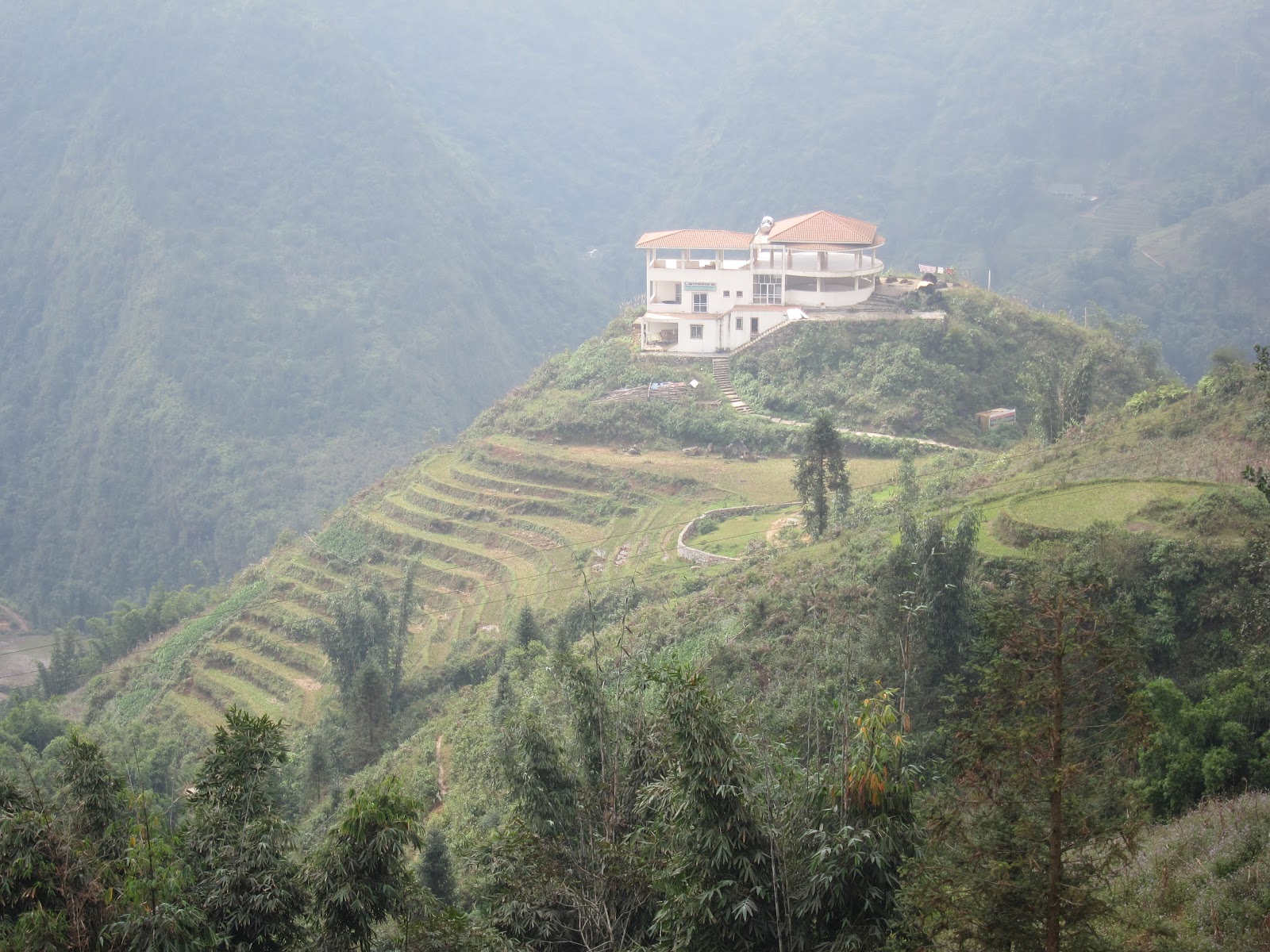
The journey from Dien Bien Phu on Saturday (17th Nov) took 9 hours and the road were probably the worst yet, although thankfully our bus wasn’t packed to rafters full of cargo and people. The roads were absolutely shocking missing proper surfacing for large parts along the way, but our driver was forceful with the bus through the mud and made short work of it. The scenery at least was the most spectacular yet. Unlike on the Lao side of these mountains, where the valleys and forest look impenetrable, the hill tribes in Vietnam have made little of the vegetation and terrain and proceeded to use it for cultivation. There are plantations of fruit trees, but overwhelmingly rice is the main occupier of these slopes.  The rice had been harvested so the paddies are not lush green of the postcards, but a light brown from the remaining stubble; nevertheless the endless rows of rice terraces are spectacular.

Not only is the landscape interesting, but the frequent villages that we travelled through are occupied by different hill tribe people. The H'mong are the most famous of these hill tribes and are well known for the unique style of ladies dress, who I might add were only too willing to wave and pose as I snapped a photo on the way past. The H'mong occupy Vietnam, China and Laos and were well known for their loyalty to the maverick CIA operative Tony Poe from Long Beach, California. He led them in their fight against the North Vietnamese forces in the Secret War in the 1960s and was the inspiration for Colonel Kurtz in the Vietnam War film Apocalypse Now.   
My wife and I discussed that although the untouched hills in Laos are beautiful they are a bit mundane after a few hours, while the human sculpted (or scarred?) Vietnamese hills seem to continually offer something of interest to the eye. I was continually twisting my head and looking at the land and the people, my wife on the other hand was still finding the journeying tough as her stomach bug still has not passed. “This is the last bus journey we are taking like this” she declared. I hope she is right, because I think we would still be in Laos if I was as sick as she was! We only have ten days left on our trip now and we are taking the train to Hanoi so hopefully any buses in the meantime will be smooth and flat.
We arrived in Sapa and it was absolutely freezing, at least that’s how it feels after being in tropical heat for the last 3 months, it feels like Autumn in Ireland and we have had to layer up to keep out the chill. Sapa is an old French hill station built in the 1920s and 30s. It’s a lovely little place, more like an apline village than anything else. The location is very picturesque with views of the mountains towering above us and the rice terrace paddies below, the swirling cloud however makes an uninterupted view nearly impossible. The hill tribes that come down from the hills to trade and sell their wares give the town a busy, bustling vibe, especially in the markets which leave nothing to the imagination on how the meat gets from live animal to food on our plates.

Vietnam’s highest peak Fansipan (3143m/10 312ft) hovers in the clouds above the town and it so happened there was a race to the summit from Sapa. A couple of Catalans from our guesthouse who were also comrades from our epic bus ride from Laos to Dien Bien Phu entered the race, one chap came fifth and was the first foreigner. Completing the 35 km (21miles) course in an impressive 3 hours and 35minutes and got prize money of 2 million Dong for his efforts! This sounds a lot better than the conversion to US dollars of $100
As a communist country you expect Vietnam to have free public health care, free education, and good workers rights, our thoughts on this were confirmed by the declaration from the narrator in the video that we saw at the Dien Bien Phu battle museum. That video proved itself to be pure propaganda as we found out that in reality these benefits are not the case in practice at all. We got chatting to the hotel staff last night, these guys work 7 days a week with only a week off a year around Tet, the Vietnamese New Year, which I am pretty sure would be illegal in most Western capitalist countries. One of the workers also told us a story about his grandfather, who has an old war injury that he required surgery for, but the best that could get for free was a few painkillers. The family had to club together to fork out for the surgery at full price. However despite our friend's frustration about his government, another guest this morning made a comment about Vietnamese being a bunch of liars and he completely flipped. Dissatisfaction with the system there clearly is, but Nationalism still runs deep here.
Thanksgiving is a festival that I have been introduced to over the past decade as I am married to an American.  Although I have never been in America for Thanksgiving, my wife and I always celebrate in our home with friends and family. Having opted to be hobos for three months, this year we don’t have a home and we are far away from turkeys and stuffing. And even with plentiful sweet potatoes and Pumpkin soup in Vietnam, a Thanksgiving dinner will most likely be out of the question. This was something we were aware of, but it is still with heavy hearts and a bout of homesickness that this reality approaches us this Thursday. Hopefully seeing family and friends soon should alleviate all that.
The city of Hue is our most likely destination for Thanksgiving and we aim to get there by tomorrow night taking a train out of these mountains tonight to Hanoi and then on to another train to Hue through the day. It will most likely mean another 24 hours travelling, but if the journey is made in trains it will be much more manageable for our rear-ends, stomachs and patience.

Friday, 16 November 2012

Dien Bien Phu

Days 83-85

We have arrived in Dien Bien Phu in Vietnam and what a welcome sight it was to us as we came off the journey from hell from Laos. Cruel though it was, undeterred we are, as we make another trip across the mountains tomorrow to the French Hill Station of Sapa, hopefully a more pleasant journey than our last bus trip.
Our first leg of the journey began at 8am on Wednesday (14th Nov) morning in Luang Prabang by boarding our minibus to Udomxai. It was a tourist minibus and although it would have been a tight squeeze had it been full, the bus was kitted out for 9 or 10 and there were only 6 of us so we could stretch our legs. The road conditions were intent on making life for our rear ends very difficult, deteriorating as we ascended through the mountains. The scenery though was magnificent with green jungle covered mountains and grey cliffs creating a dramatic landscape. The land in Laos is pretty much untamed and the few villages that we passed through had allocated themselves just a few acres worth of land for their provisions, which was mostly used for rice. It was quickly apparent why Laos has such a low GDP, many of these villages appear to be at a virtually subsistence level with bamboo huts and minimal livestock.  Although someone was making money in town because every village we passed through had at least a few of the ever popular twin cab pickups.
Luckily, we reached Udomxai an hour or so before the bus left to Muang Khua, the village that would be our stop over for the night before making the crossing to Vietnam. The bus this time was a rickety little affair which shipped goods as well as people. The seats were much too small to sit in comfortably, clearly made with a different body size in mind. The route took us along a river valley and passed some beautiful countryside. The hills were lined with bamboo forest, the bamboo grew in great bunches and resembled giant ferns as each stalk drooped under their own weight over after growing so tall.
The light had just faded by the time we reached the remote village of Muang Khua. There isn’t too much to this town but like a lot of Laos it does get a number of tourists passing through so it did have accommodation, if you could call our room for night that. I have seen suck calves on our farm have more luxurious digs that we had the night. It was only for one night though so we went off to bed early as we had to be up for a bus that left on Wednesday at a miscellaneous time. We had been told “6 o’clock”, “6.30”, “8 o’clock”, “10 o’clock” and “11 o’clock”, every person who we asked (that could speak English) told us something different. One thing they at least seemed to agree was there was a bus going so we decided to be up and at the village cross roads for 6 o’clock, we were in bed by 9pm so this should not have been a problem.
The much sought after sleep for the tough day ahead was hard come by that night. The first problem presented itself was the lack of windows in our room and abundance of children who were up past their bedtime. This along with karaoke persisted until about 10.30pm. But then by wife’s stomach starting rumbling… Despite eating an identical diet to myself for the previous 2 days prior, my wife took ill with a bout of vomiting. And despite a limited night’s sleep and feeling dreadful she bravely made her way to the bus stop at 5.45am on Thursday (15th Nov) morning.
We meet a Belgian chap who was also waiting for the bus and he too had got lots of conflicting information about the time the bus left. We were optimistic as there was a bus sitting at the bus stop pointed in the direction of Vietnam. However 6 o’clock came and went, so did 6.30 and our hope started to wane. Our optimism rose to fever pitch when a driver came to the bus but then he quickly squashed our hope by turning the bus around and heading in the other direction. One of the shop owners then told me that the bus would be leaving at 11am, than we got the same information again, it looked like our early start had been in vain. It was particularly demoralizing for my wife who had to go and be sick again behind a pile of gravel when she could still have been in bed recovering.
The bus arrived at 11.10am which I was impressed with, for Laos this is razor sharp efficiency! In the meantime a total of 10 foreigners had gathered for the bus. The bus looked to have only a few seats available but in our now well prerehearsed drill my wife took our small bags and herself onto the bus thus booking our seats while I waited outside with our backpacks to hand them up to be put on the roof. When I entered the bus I was in for quite a shock. Luckily my wife had got us seats, but the entire floor of the bus was covered with red bull boxes, in affect raising the floor level of the bus. The knee space in these buses is pretty much nonexistent anyway but the boxes on the floor meant wedging yourself into the seat and leaving your feet with about an inch of movement. 

By comparison the back two rows of seats in the bus were stuffed with a variety of goods for transport, including live chicks, yes we were officially on a chicken bus! Four of the tourists squeezed themselves in between this assortment of goods and the roof of the bus. We had it lucky! The people continued to pile onto the bus and by the time the bus pulled out it had enough goods to fill two transit vans and 28 people on board.

After a few stops and starts the bus got going in earnest after about an hour. Luckily the Lao authorities have been upgrading the road and we had a great surface to ride on into the mountains, although it followed the contours of the land and was full of hairpin bends.
We stopped after about an hour for lunch, the stretch of legs was most welcome but I would really have preferred to keep going as the stop was about an hour in total. When all the passengers got reloaded on the bus it appeared something was not right. The driver was blowing his horn and looking very agitated, it looked like someone was missing. In my country and in just about every other country I have been to, if you aren’t there when the bus driver is ready to go its tough luck, but I guess in Laos it would be bad karma to leave someone in one of these mountain villages for the night. The driver although clearly exasperated wasn’t going without all his passengers. So he turned the bus around and went through the village blowing his horn, the two tardy ladies appeared from a house in the village and upon much smiling from the local passengers and frowning from the foreign ones they were back on board and we were heading upwards to the border.
The road now ascended relentlessly through some stunning wild country. Endless green valleys as far as the eye could see with no villages for miles, only jungle. The road as well was empty with little or no traffic passing us. Eventually we got to the Lao border post and we were duly stamped out apart from one French man. This guy had decided he would try and get into the Vietnam before the entry date on his visa. Since it was only a few days difference he thought it would not be a problem. The Vietnamese border officials thought different and he was sent back on his way back down the mountain to Muang Khua. He hitched a ride with a lorry driver who was near delirious on receiving a few US$ for the lift. I felt sorry for the guy having to make this pointless trip but after a bit of consideration I didn’t feel any at all. Why did he come anywhere near the border before his date of entry? 
It was then back on the bus for the few kilometers to the Vietnam border post and were we were duly stamped in. The road on the Vietnamese side was very poor by compassion and in the fading light we made our way down past a Metso powered quarry to the town of Dien Bien Phu. Our crazy journey was at an end 35 hours after leaving Luang Prabang.
Dien Bien Phu is locating on a flat piece of ground and is completely surrounded by mountains. In 1953 the French colonial forces built a huge garrison here that was supplied by an airstrip. The French had been struggling in their war against the Vietnamese nationalist forces and the purpose was to cut their supply lines and draw them into a battle that would bleed them dry. The French of course didn’t count on the Vietnamese having anti-aircraft guns or heavy artillery, and if they did manage to get some it didn’t matter as there were no roads to Dien Bien Phu to get them there. But the Viet Minh did have artillery and they pulled them through the mountians to lay siege to the French garrison. With AA guns on the scene and their only supply route through the air, it was ominous for the French and the Vietnamese overran the garrison in May 1954 after some ferocious fighting. Since the French had invested so heavily in the garrison and with the nature of their defeat, their rule in Indochina was all over, bar the shouting.
After a smelly night in our initial hotel we spent Friday (16th Nov) morning finding a new one before heading to the museum of the battle of Dien Bien Phu. The museum has some decent artifacts and a propaganda video to the battle but it is slightly one sided as you would expect but more disappointingly lacking in detail on the battle. But the beer here is $0.50 for a 450ml bottle so a few of those numbed my disappointment.
With my wife now on the mend we have nominated ourselves for another early start we are now heading for Sapa to the north. The mountain scenery on the bus trip is touted as being spectacular. Our trip is now got less than two weeks remaining and while we are glad in some ways to be heading home we are still keen to see as much of Vietnam as possible.

Tuesday, 13 November 2012

Luang Prabang


Days 80-82
Luang Prabang’s relaxed atmosphere and comfortable temperature have been the perfect place to recharge our batteries and gather ourselves for the tough journey ahead. There are a lot of tourists here and lots of activities but we have elected to do nothing only wander the French colonial streets and visit a few Buddhist temples. The notorious road ahead will take us further north and into the mountain before crossing the border into Vietnam.
Arriving at a bus station in a town you have never been before leaves you vulnerable to the consistently unscrupulous tuktuk drivers. We paid 20 000kip (£1.6/$2.50) each for a journey of about 3km/2miles, and there was five of us in the tuktuk, which means he made £8/$12.50 from the trip. It is half a day’s pay for the driver but it is a pattern that has been repeated again and again at bus and train stations throughout South East Asia. Another feature of the SE Asian tuktuk drivers is that they stick together when it comes to tourists so there is no point trying to auction a few drivers against each other, they just won’t have it, and will quickly move on to the next gullible foreigner. India on the other hand was a different ball game, an infinite number of tuktuk drivers would scrabble on top of each other to undercut the guy in front to get your fare and you soon had a fair price.
Luanag Prabang is a small town famous for its monasteries, temples and French colonial architecture on the banks of the muddy Mekong. It is firmly on the tourist SE Asia tourist trail and there are hundreds of tourists wandering its streets and of course all the usual trinket and tour sellers that come with them. It is not hard to get away from this though if you cut off the main street, where you will be transported to a different era where the streets are formed by houses with wooden shuttered windows and tiled roofs giving you the feeling you are in a provincial French town, until out of nowhere you stumble across one of the Buddhist monasteries and temples within which dwell the town’s famous monks. 
There are dozens of monasteries around town with hundreds of monks, who every morning march out of their monasteries in single file to collect their daily alms from the locals at dawn. Since the monks live a life of prayer free from material possessions they rely on donations from the locals to eat. This food is collected each morning in the centuries old tradition of alms giving and is one of the reasons why so many people flock to Luang Prabang. So along with all the other tourists we got up at 6am on Monday (12th Nov) morning to see the spectacle. It’s a humbling thing to see these monks, some of who are no more than 10 years old, wandering the streets and collecting their rice for the day to enable them to continue their life of prayer. The addition of tourists to the ceremony is a little more frustrating, some of whom are a little over zealous in the keenness to get their National Geographic shots using flash and get right in the monks faces. The serene monks though, endure it all and their orange lines soon march back to their monasteries.
Luanag Pabang was the capital of the former Kingdom of Laos and the seat of Royal Residence of the Royal Family of Laos. However their support of the French and Americans in Vietnam meant that the 600 year old monarchy’s days were numbered. And in the Lao communist revolution of 1975, Prathet Lao deposed the monarchy and sent them to a “re-education” camp. The current heir to the defunct throne lives in France and is still agitating for an end to Communist rule and democracy in Laos along with this his reinstatement. But with communist China and Vietnam right next door, the chance of any change to the political system in Laos are minimal. We visited the monarchy’s former Palace after attending the alms giving ceremony and to be honest it wasn’t really that great. The most interesting thing that we found was a gift from the American government, a piece of moon rock.
The French reign in IndoChina was fairly brief (67 years) in comparison to the British in India (330 years) but their influence has ran deep. Nowhere is this more evident by the food, everywhere you look there are baguettes and wine, look into a more upmarket restaurant and it will be dominated by French dishes. A row of baguette stalls close to our hotel has been our savior serving up bagette subs filled with salads, meats and to my wife’s delight: Nutella and even avocado. With not having the usual worry of dabbling with local cuisine for a cheap bite these stalls have made our stay here very relaxed, welcome and cheap. Although if anyone wants to make their stay here cheaper still I would advise them not to pay into any of the fancier temples, there are dozens of temples around town that you can enter for free.
The journey that I alluded to earlier is to Dien Bien Phu in Vietnam and begins tomorrow (Wed 14th) at 8am. I am not keen on the trip itself as I have heard lots of horror stories of muddy mountain roads and rickety old buses guaranteed to break down. However the views are supposed to be spectacular and Dien Bien Phu is a place I have always wanted to visit purely to satisfy my inner historical nerd. All of you history buffs will be aware that it was the site of the famous battle between the Colonial French and the Vietnamese Nationalist movement, the Viet Minh in 1954. After both going to extraordinary lengths to defeat each other it ended in a crushing defeat of the French and marked an end to the age of colonialism and the French Empire.
The journey is long and we will have a black out on communications until we reach Vietnam, which will take us 2 or (hopefully not!) 3 days. So I will pick up all my loyal readers then in the final country of our trip; Vietnam.
Since this is a relatively short post I thought I would take the opportunity to tell you that I actually won’t be releasing anymore India Diaries post. It’s not that I haven’t written them, it’s just that they are a bit to opinionated to be publishing on the internet. Most of what I written in my location posts has been reasonably diplomatic, however those of you that know me will know that I can be quite opinionated and when reviewing certain things in India all of these opinions came out. So I decided to apply the Irish saying “whatever you say, say nothing” and decided not to bother publishing them.
Don’t be disappointed though. We will be doing a review at the end of the trip and to spice it up a bit it will be in the form of awards to the best (and worst) aspects of our trip.

Saturday, 10 November 2012

Vientiane


Days 77-80
We arrived this morning (Sun 11th Nov) in Luang Prabang in north central Laos from Vientiane, which didn’t prove worthy enough of a 2 night stay. As predicted our journey from Siem Reap to Vientiane proved to be extremely difficult and our efforts to make the trip in one day proved to be in vain.
Our route to Laos from Siem Reap involved retracing our steps through the grungy little border town of Poipet, from there it was onto Khorat, Thailand’s second city where we would catch a bus to the Laos border. Here we would meet up with the Mekong once again and cross to on our way to Vientiane, the capital of Laos . To try and get a jump start on our journey we hired a taxi at 6.30am Thursday (8thNov) morning from Siem Reap. However our start wasn’t early enough, our driver wasn’t fast enough and we missed the 9.00am bus to Khorat. No problem, there was a noon bus so just a 2 hour wait. The noon bus arrived and as we prepared to board word filtered out to us that the bus was going nowhere until 3.00pm. Although the rest of the passengers seemed indifferent to the news, we were dejected. A five hour wait would mean the chances of getting to Laos before the day was out impossible, and frustratingly rendering our taxi fare and early start pointless. It didn’t end there though, when it was closing in to 3 o’clock I noticed my right arm and leg sun burnt despite the fact I had been sitting in the shade all day. Turns out the reflection from the bus that should have motoring us to Khorat was reflecting UV waves my direction! I have been extremely careful with sunburn on this trip because my transparent skin will burn very easily in the tropical sun and this annoyed me, how could I forsee being burnt in the shade by the very thing that should have been protecting me? Could this journey get any worse?
Thankfully it didn’t and the bus to Khorat was off at 3pm and despite a traffic jam along the way we got there unscathed at least. Once we arrived in Khorat it was apparent that our luck had completed a U-Turn, as it turned out we could catch a night bus to the Laos border. The bus was fantastic and although we didn’t have seats together we had full reclining seats so we both slept soundly the whole way to the border, saving us the cost of accommodation for the night to boot.
We were at the border for 6am Friday (9th Nov) morning and were duly punished for arriving too early with a $1 overtime fee for the Lao visa. $1 is no big deal and as we hadn’t fully researched the visa price we were at the mercy of the price quoted from the official. The conductor of the bus that took us from the border to Vientiane decided that he was also entitled to an overtime fee, even after our price had been agreed at 100bhat. Backed up by a French couple behind us we told him a firm no and waited to see what happened. Nothing as it turned out, it would appear the conductor was chancing his arm at a bit of pocket money!
My knowledge on Laos is fairly scant. I know that it is often quoted as one of the poorest countries in the world. It has a small devoutly Buddhist population who live a mainly rural and subsistence lifestyle. I was also aware that there are many different ethnic groups who associate more with each other than the country itself. Its history also records it as one of the most bombed countries in the world during the Vietnam War. So as we entered Vientiane I was preparing myself for a huge disparity in the development level from Thailand, boy was I in for a surprise.
At 200 000 inhabitants it is very small city but not at all bustling like a typical Asian city or at all ramshackle like you would associate with its GDP level . Vientiane has wide clean streets with brand new twin cab pick-ups roaring down them.  There are new hotels, stylish coffee shops, squeaky clean government buildings and a newly developed waterfront area on the banks of the Mekong. Strangely, it actually doesn’t feel unlike suburban Southern California.
It’s all very nice but the problem is, it is all a bit boring, there is nothing to really do here. There are a few temples but nothing I could really highly recommend. The other problem of course is the stifling heat. The oppressive humidity from further south is gone but during the day the sun beats down with such strength and intensity that anywhere out of the shade around midday is a no-go area for me, especially with my previous day burning.
What Vientiane does have though and just around the corner from our hotel as it turns out, is a bowling alley. So like just like Walter and the Dude, when there is nothing else to do to but escape the heat and waste away a few hours my special lady friend and I said “***k it, let’s go bowling”. And bowl we did, althought I am not sure that Walter would have approved of the flag in our lane. It ended honours even, my special lady friend game greatly improved under my guidance when she defeated me in the second game. Then, what seemed like an entire year group of school girls from Vientiane International School invaded the empty alley and we had to beat a hasty retreat. It seems that the heat in Vientiane is too much for even the local’s Physical Education class.
We did a small amount of sightseeing on Saturday (10th Nov) but the main temples in the centre of town, Wat Si Saket and Haw Pha Kaew actually close at 4.00pm just when it is starting to cool off so we only got to walk around their grounds. The main temple in Vientiane is called Pha That Luang, but we didn’t visit it as we weren’t blown away by the reviews and it was far too hot to cycle or walk there anyway.

 We discoverd something from our sightseeing though. With the increase in Buddhists in Northern Ireland it has left people wondering what side of the political divide they lie. Well with all the orange around I was already suspect but we saw this image of the Buddha which removes all doubt! So there you have it, I bet those hands were even painted red at one time!


 The nights do cool off, but it appears that Vientiane is also infested with bedbugs. Yes those dreaded little nasties again! There were a couple of girls from Co Down in our hotel who got badly bitten, we escaped with only a few bites this time around. Apparently it is a city wide problem so its hard to blame the hotel owners and they were taking the mattress out when we checked out the next morning.
With one night under our belt we decided it would be enough and we caught the night bus to Luang Prabang directly North from Vientiane. Unfortunately as it was dark we couldn’t see the landscape, but in consolation once again the bus offset the price of a night’s accommodation. The landscape around the town of Vang Vieng is supposed to be particularly beautiful with Karst cliffs dissected with winding rivers. But the town has become famous for another reason; “Inner-tubing”.  
Inner-tubing involves sitting in a tractor tyre inner tube and floating down a river. Vang Vieng decided to start adding bars along the tubing route, so you could float down the river and sip a few beers along the way. Sounds a nice way to spend the day but as it got popular the bars started to up their game adding rave music, pole dancers, a few locals decided to satisfy the tourist’s demand for marijuana and next came crystal meth. As you can imagine soon enough it was completely out of control and 22 tourists drowned last year. The local authorities had to act and when shooting the drug dealers didn’t work they closed down the bars on the tubing route a few months back. As a result the party going backpackers have deserted it, but I am sure that given a few years a more sustainable tourism will reappear.
On a related point we also met a woman yesterday who said you can volunteer at the Full Moon party in Koh Pha-Ngan with the purpose of helping the young tourists who have consumed too much of whatever they were consuming that night. This volunteering involves finding party goers sprawled senseless, putting them in a cage, and then feeding and releasing them in the morning. The amount of fights and rapes at the Full Moon party actually make this a necessity, but there are more worthwhile volunteering projects that should be receiving help in SE Asia. Also I am quite sure it is not the way that the parents’ of these inebriated youths thought that they’re money was being spent when the apple of their eye said they wanted “to go and see the world”.
Last night’s bus had fully reclining seats were you actually could lie flat, although ours were a little close together. They worked perfectly for me and I slept soundly, not so for my wife and she now is catching 40 winks while I write this post. There was also an interesting sign on the toilet that my wife was glad to see as she was sitting right next to it, see the photo below. Luang Prabang is thankfully much cooler than Vientiane and we intend to spend a few nights here recuperating from our nights on the road before making the push over the Tonkinese Alps and into Vietnam.
With virtually the main core of Ireland’s rugby team decimated for their match against South Africa, I wasn’t holding out much hope for a win yesterday evening. But from the report it seems that they performed well and perhaps could have beaten the Springboks. Still though, a lot of our big name players are getting on a bit and aren’t going to be around forever so the younger guys will have to step it up from now on. Also wondering why if the match was in Dublin, why were Ireland in a changed strip?